EN
EN
 fr
fr  de
de  es
es  it
it  ru
ru  pt
pt  ar
ar  vi
vi  tr
tr  id
id 
Phone:
0086 27 688745330086 18049845758
 GOLDEN PAPER

.webp "Digital Transfer Paper/Sublimation Paper")




In my last article, I explained what grain direction in paper is and how to identify it. But do you know how paper grain direction actually affects paper performance? In this post, I’ll walk you through the major impacts of paper grain direction. Whether you’re in the printing industry or the packaging industry, understanding this is essential. Let’s dive in!

Grain direction mainly affects paper’s dimensional stability through expansion and shrinkage differences.
Expansion: When paper fibers absorb moisture, expansion is greater across the grain (cross direction) than along the grain (machine direction). This can cause curling or warping when humidity changes. For example, during offset printing, fountain solution adds moisture. If the paper grain runs perpendicular to the printing cylinder, cross-grain expansion can lead to registration problems.
Shrinkage: During drying, paper also shrinks differently depending on grain direction. This uneven shrinkage makes paper size less stable, which may reduce accuracy in post-printing processes such as folding and bookbinding. In high-precision industries like packaging for pharmaceuticals or cosmetics, even small dimensional changes can affect fit and sealing, which makes grain direction management critical.
Tensile strength: Paper is generally stronger along the grain direction than across it. That’s why aligning the grain with the stress direction is important in packaging. For example, when making cartons, if the grain direction of paperboard matches the box’s stress direction, the structure holds up better and reduces tearing risks.
In corrugated board production, the fluted medium runs in a wave-like direction called the “flute direction.” When combining linerboard with the flutes, it’s best to position the grain direction perpendicular to the flute direction. This not only keeps corrugated boxes flat but also increases overall strength.
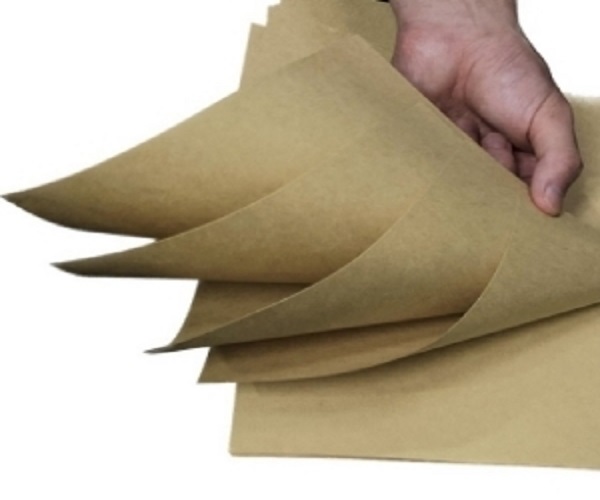
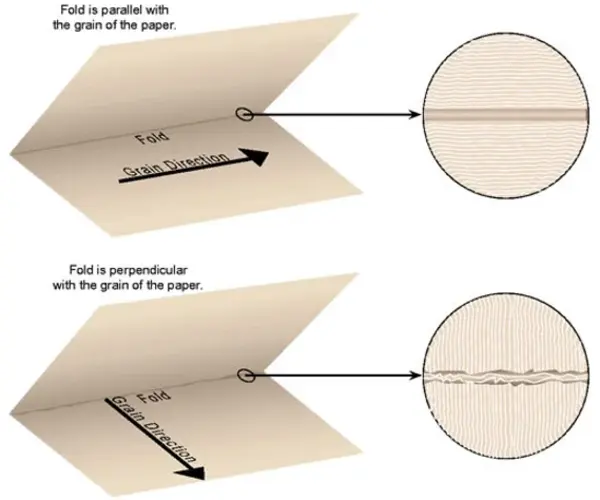
Stiffness and flexibility: Paper is stiffer along the grain direction. Folding or bending with the grain produces smoother, cleaner creases. Folding against the grain, however, can lead to cracks and rough edges. For heavy-duty applications such as e-commerce shipping cartons, improper grain alignment can reduce stacking strength and lead to collapsed boxes during transit.
Registration accuracy: Because grain direction impacts expansion, aligning the grain direction with the press cylinder axis reduces misregistration. Wrong grain alignment can cause issues such as smearing, slurring, or registration shifts—especially on thicker papers or large solid print areas.
Paper feeding stability: Grain direction also affects how smoothly paper feeds through printing presses. If the grain runs perpendicular to the feed path, paper maintains stiffness along the rollers, preventing wrinkles and ensuring continuous feeding. This is especially relevant in high-speed offset or digital printing, where poor feeding can cause downtime and wasted sheets. Printers often request “grain long” or “grain short” paper depending on the specific job to avoid these issues.
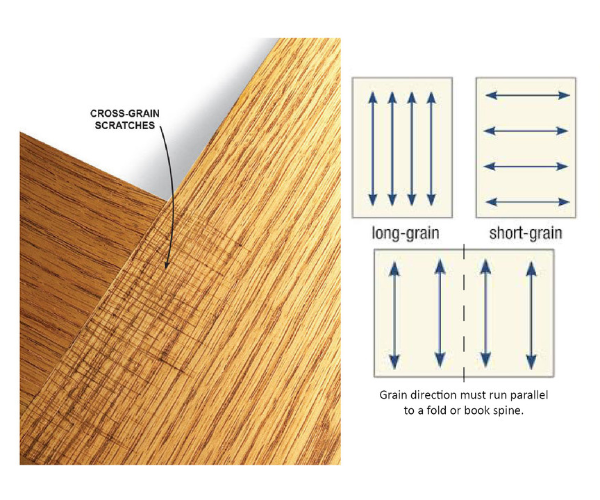
Folding and binding: For neat folds, paper grain should run parallel to the fold line. In bookbinding, the grain direction of paper sheets should run parallel to the spine. This makes books open flatter and improves reading comfort.
Labeling and packaging: For bottle labels, the paper grain should run perpendicular to the bottle axis to prevent curling from moisture. For paperboard cartons, aligning the grain with the vertical edges increases compression strength, protecting boxes from deformation during transport or stacking. Many premium packaging suppliers specifically test grain direction before production to ensure better shelf appearance and product protection. Grain control is therefore part of quality assurance in printing and packaging.
Grain direction is an inherent characteristic of papermaking that directly affects the physical properties and performance of paper. In fields such as printing and packaging, making good use of grain direction can improve product quality and reduce loss. On the contrary, ignoring it may cause dimensional deformation, registration errors, and processing difficulties. Therefore, correctly identifying and applying paper grain direction is the key to ensuring production efficiency and product quality. If you have any questions or paper purchasing needs, please feel free to contact us at Golden Paper!